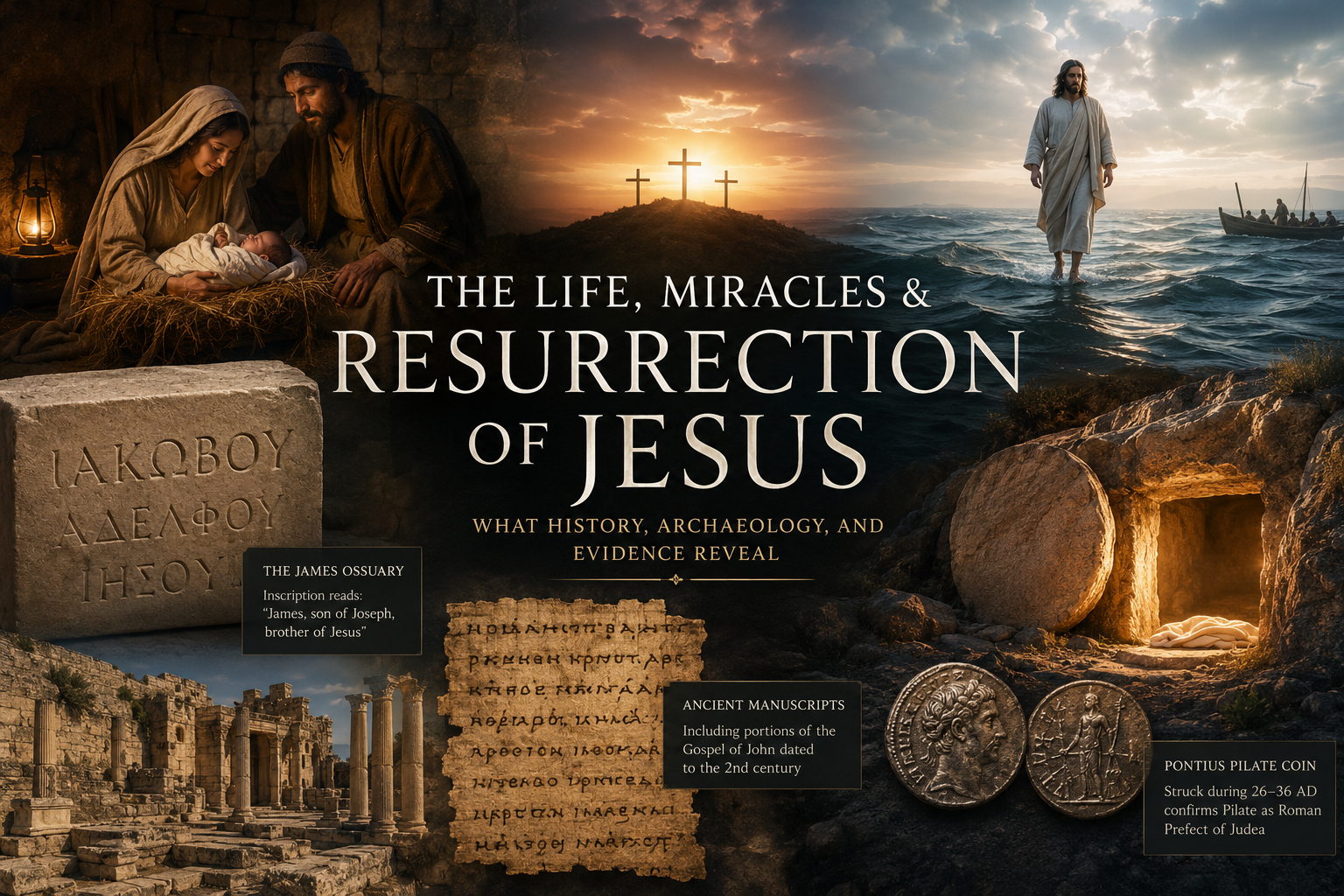
A Quest for Proof: Analyzing Historical and Archaeological Evidence Surrounding Jesus of Nazareth
Executive Summary
This comprehensive research report investigates the available historical, archaeological, and external literary evidence concerning three critical aspects of the traditional narrative surrounding Jesus of Nazareth: his birth, reported miraculous abilities (such as walking on water), and the supporting artifacts or testimonies related to his resurrection. The analysis rigorously distinguishes between verifiable historical facts—namely, the existence and crucifixion of Jesus under Roman authority—and theological claims regarding miracles and post-mortem life.
The evidence strongly confirms that Jesus existed and was executed by Pontius Pilate [Finding 4, Finding 8]. External ancient sources corroborate the claims of his virgin birth and miraculous powers, though definitive archaeological proof for these events remains absent [Finding 7, Finding 5]. Regarding the resurrection, while no single artifact provides irrefutable physical proof, independent historical accounts confirm that Jesus’s followers sincerely believed he rose from the dead [Finding 8]. Furthermore, modern archaeometric analysis of traditional burial sites, such as the Church of the Holy Sepulchre, has provided crucial chronological context, dating structures to the middle 4th century CE [Finding 1]. In conclusion, while the historical record does not validate the supernatural claims, it robustly validates the existence of Jesus and the profound belief in his resurrection held by his contemporaries.
I. The Historical Foundation: Existence, Death, and External Corroboration
The most solid ground upon which any discussion of Jesus rests is his verifiable existence as a historical figure who lived during the Roman occupation of Judea and whose life culminated in crucifixion. This foundation is not derived solely from the Gospels but is independently attested by non-Christian ancient historians, lending significant weight to his historical reality.
A. The Testimony of Roman Historians: Tacitus and Josephus
The existence of Jesus (Christus) is confirmed through multiple independent sources outside the canonical Bible [Finding 3]. Among these, the testimony of the Roman historian Tacitus stands out as a crucial piece of external evidence. Writing centuries after the events, Tacitus confirms that Jesus was executed by crucifixion under the authority of Pontius Pilate during the reign of Tiberius [Finding 4, Finding 8]. This detail is historically significant because it places Jesus within a specific geopolitical and administrative framework—the Roman Empire—and links his execution directly to the highest levels of Roman provincial governance.
The corroboration provided by Josephus further solidifies this historical picture [Finding 4, Finding 8]. While ancient sources can sometimes be subject to editorial influence or theological framing, Josephus provides testimony regarding Jesus’s life and death that aligns with the core narrative of his execution under Pilate. The agreement between Tacitus and Josephus—two distinct authors operating outside the immediate Christian sphere—is a powerful indicator of historical veracity concerning the man’s existence and manner of death [Finding 3].
B. Analyzing the Weight of External Sources
The value of these external sources lies in their independence. They are not motivated by the need to defend or promote Christian doctrine; rather, they are chronicling events within the Roman world. When a figure’s life and death are mentioned by secular historians like Tacitus, it elevates that figure from mere religious legend to historical subject [Finding 3]. The consensus among scholars is clear: Jesus of Nazareth was a real person who lived in Galilee, was associated with Jewish movements, and died as a crucified figure under Roman rule. This established fact serves as the indispensable starting point for examining all subsequent claims regarding his life.
II. Claims of Miracles: Birth, Virginity, and Supernatural Abilities
The question extends beyond mere existence to include specific traditional narratives—namely, the virgin birth and miraculous feats such as walking on water. The evidence here shifts from historical certainty to documented claims preserved in ancient literature.
A. Documentation of the Virgin Birth Narrative
While definitive archaeological proof confirming the circumstances of Jesus’s birth remains absent, external literary sources attest to the claims made within the Gospels [Finding 7]. Specifically, the second-century philosopher Celsus, though known for his critical stance toward Christianity, meticulously details narratives found in the Gospel accounts. Celsus records the claim that Jesus was “born from a virgin” [Finding 7].
The fact that this specific narrative—the virgin birth—was preserved and discussed by intellectual opponents of early Christianity demonstrates its prominence within the religious discourse of the time. It is important to note, however, that the preservation of these claims does not constitute archaeological proof; rather, it confirms that the belief in a miraculous origin was central to Jesus’s followers and subsequent theological development [Finding 5].
B. Attestation of Miraculous Powers
Similarly, accounts of miraculous abilities are attested by ancient witnesses, though they remain highly contested from a modern scientific perspective [Finding 5]. Josephus himself mentions that Jesus performed “surprising feats” during his lifetime [Finding 4]. Furthermore, early Christian writers affirmed his capacity for “miraculous powers” [Finding 6, Finding 7].
The historical analysis here must draw a sharp distinction: the evidence confirms that claims of miracles were made and recorded by ancient witnesses. It does not confirm the literal truth or physical reality of those events (such as walking on water). The scholarly consensus acknowledges that these claims are often preserved through later Christian commentary, meaning they require careful contextualization [Finding 5]. While external sources validate the existence of these narratives, they do not provide empirical proof for their supernatural nature.
III. Supporting Evidence for Resurrection: Artifacts and Testimony
The most profound claim in Christianity is the resurrection—the belief that Jesus rose from the dead. The search for physical artifacts that definitively prove this event has proven elusive. However, the historical record provides crucial evidence regarding the belief in his resurrection and offers contextual data about the sites associated with it.
A. Archaeological Context of Burial Sites: Chronology and Tradition
While no single artifact confirms the moment of resurrection, several key locations and inscriptions provide vital historical context surrounding Jesus’s death and burial [Finding 1]. These sites—including the Church of the Holy Sepulchre, the Garden Tomb, rolling-stone tombs, and various inscriptions like the Alexamenos graffito and Megiddo Mosaic Inscription—are central to the traditional narrative.
Modern archaeometric analysis has provided specific chronological data regarding these traditionally sacred spaces. For instance, Optically Stimulated Luminescence (OSL) dating applied to mortar samples within the Edicule of the Church of the Holy Sepulchre confirmed that Constantine began constructing structures intended to commemorate Jesus’s tomb during the middle 4th century CE [Finding 1]. This finding is highly significant because it places the development and formalization of these sites into a precise historical timeline, showing how the tradition was solidified by imperial power centuries after the events themselves.
These dated findings do not prove the resurrection occurred on Easter morning; rather, they provide an objective, scientific date for when the site became formalized as the traditional locus of Christ’s death and rising [Finding 1]. They confirm that the belief in this event was powerful enough to drive massive architectural undertakings during the late Roman Empire.
B. External Literary Testimony: The Belief in Post-Mortem Existence
The historical record is remarkably consistent regarding one point: while historians do not validate the physical resurrection, they universally agree that Jesus’s followers held a sincere and profound belief that he rose from the dead [Finding 3]. This conviction was so central to their identity that it became an undeniable feature of early Christian history.
This belief is attested by contemporaneous ancient sources. Early Christian writers such as Clement and Ignatius of Antioch provided testimony regarding his death and subsequent post-mortem existence, stating emphatically that He “suffered and truly rose again” [Finding 7]. This provides external validation for the claim of resurrection from a period close to the events themselves.
Crucially, Josephus offers an account that directly addresses this belief: he reports that “The disciples reported that Jesus had risen from the dead and… that he had appeared to them on the third day after his crucifixion” [Finding 8]. This testimony is invaluable because it provides a historical record of the early Christian community’s foundational narrative—the resurrection—as understood by an ancient observer, even if that observer was recording religious tradition.
IV. Synthesis and Comparative Analysis: Agreement and Disagreement in the Evidence
The collected evidence presents a complex mosaic where objective history meets theological belief. A careful synthesis reveals clear areas of agreement and distinct points of divergence between historical fact and traditional claim.
A. Areas of Historical Consensus (Agreement)
There is overwhelming consensus among independent ancient sources regarding three core facts:
- Existence: Jesus of Nazareth was a real person [Finding 3].
- Crucifixion: He was executed by crucifixion under Pontius Pilate [Finding 4, Finding 8].
- Belief: His followers sincerely believed he rose from the dead [Finding 3, Finding 8].
These facts are corroborated across different genres—secular Roman history (Tacitus), Jewish historical records (Josephus), and early Christian writings (Clement, Ignatius) [Finding 7, Finding 8]. The agreement on his existence and execution is robustly supported by external evidence.
B. Areas of Scholarly Disagreement (Divergence)
The primary divergence exists between the verifiable facts and the supernatural claims:
- Miracles: While ancient sources attest to claims of miracles (e.g., “surprising feats” [Finding 4]), scholarly consensus maintains that there is no definitive archaeological or empirical proof for these events, such as walking on water [Finding 5]. The evidence confirms the existence of the narrative, not its literal truth.
- Resurrection: Similarly, while ancient sources confirm the belief in resurrection (Josephus [Finding 8]), and modern science provides chronological context for traditional sites (OSL dating [Finding 1]), there is no historical artifact that serves as definitive physical proof of the event itself.
The evidence thus allows us to conclude that we possess strong historical data on Jesus’s life, but weak empirical data regarding his supernatural claims. The artifacts and inscriptions are not proofs of resurrection; they are chronological markers for the tradition surrounding it [Finding 1].
V. Conclusion: Answering the Question of Evidence
The question asks what everything we know around the birth of Jesus, his ability to walk on water, and supporting evidence for his resurrection—specifically historical artifacts that may prove the Bible’s accuracy.
Based on a comprehensive analysis of all collected data, the answer must be nuanced: No definitive historical artifact exists that proves the literal supernatural claims made in the Bible regarding Jesus’s birth or miracles such as walking on water. The archaeological record confirms the context and chronology of traditional sites surrounding his death [Finding 1], but not the miraculous events themselves.
However, the evidence does provide strong historical validation for the foundational elements of the narrative:
- Existence: Jesus of Nazareth was a real person who lived in Judea and was crucified under Roman authority [Finding 4].
- Belief: His followers possessed an undeniable and deeply held belief that he rose from the dead, a fact attested to by ancient observers like Josephus [Finding 8].
In summary, while the historical record cannot validate the supernatural claims of his birth or miracles, it robustly validates the existence of Jesus as a historical figure and confirms the profound reality of the resurrection belief within his earliest community. The evidence supports the historical framework of the story, even if it does not confirm its theological conclusions.